
As the previous exercises have shown, lines are a useful tool in composition and direct the viewer's gaze in the path the eye is intended to follow. Implied lines work in the same way - the brain seeks to resolve the completeness of the line, and will naturally imply a line so the eye can follow a path. In essence the eye and the brain are working together to resolve incomplete things. An implied line is an example of Gestalt's Law of Good Continuation - the brain implies a line to resolve its direction(1). Essentially, the eye follows a line and it tries to construct or continue this from the implied surroundings or suggestions - and the stronger the encouragement, eg, diagonals and curves, then the eye will resolve or complete the flow of movement.
Exercise Implied Lines:
This exercise is in three parts.
Firstly, we were asked to identify the direction of the implied lines in the following photographs.

Photograph 1: There are two distinct lines intimating motion. One moves up the bulls back and over the Matador and along the outstretched cape. The other prominent line, flows down the back of the matador. I have looked at this image a few times, and can also see a circle at play, one which curves along the ground by the Matador and moves around up the bulls back and down the back of the Matador - this is a good example of Gestalt's law of Good Continuation at play.

Photograph 2: Again, the eye seeks to resolve a line of movement for it to follow. Here, there are two distinct diagonals travelling up (or down) from the ground up each mule. Secondly, there is a curve which flows from the left hand side of the image across over the top of the mules, and up and over the farmer. The gaze or eye line from mules towards the farmer is a good indication of the direction of the implied line.
In the second part of the exercise, we were asked find three existing photographs and identify implied lines.

Photograph 1: The diagonal line is very strong in this photograph and dissects the frame, the other lines are implied by the directional gaze of the boys looking down into the stream. There is a sense of movement and flow in this image.

Photograph 2: Here there is an implied diagonal line which travels across the back of the ducks (the ducks are arranged in a diagonal line). There is also an implied line from the eye line gaze of the ducks to the ground.

Photograph 3: Here there are a number of implied lines, the diagonal lines travelling down the back of the boy to the floor and another diagonal down the boys arm. There is an inverted triangle in the shape of the boys legs and an eye line in the gaze between the two children. There is also a curved line, moving down (or upwards) the girls arm - this curve is in contrast to the sharper lines of the diagonal and appears more elegant and smooth.
The third part of this exercise involved me taking the following two photographs which illustrate implied lines.


The third part of this exercise involved me taking the following two photographs which illustrate implied lines.

photograph 1. In this image, the implied lines are the eye line gaze from the small child to the toy. Our line of vision is immediately drawn along to the path of the child's gaze. Other lines which suggest flow and movement are the implied horizontal and vertical lines along the boys arm. Considering the boy as a shape - I can see a triangle. Shapes are another element of design which we shall cover in the exercise.
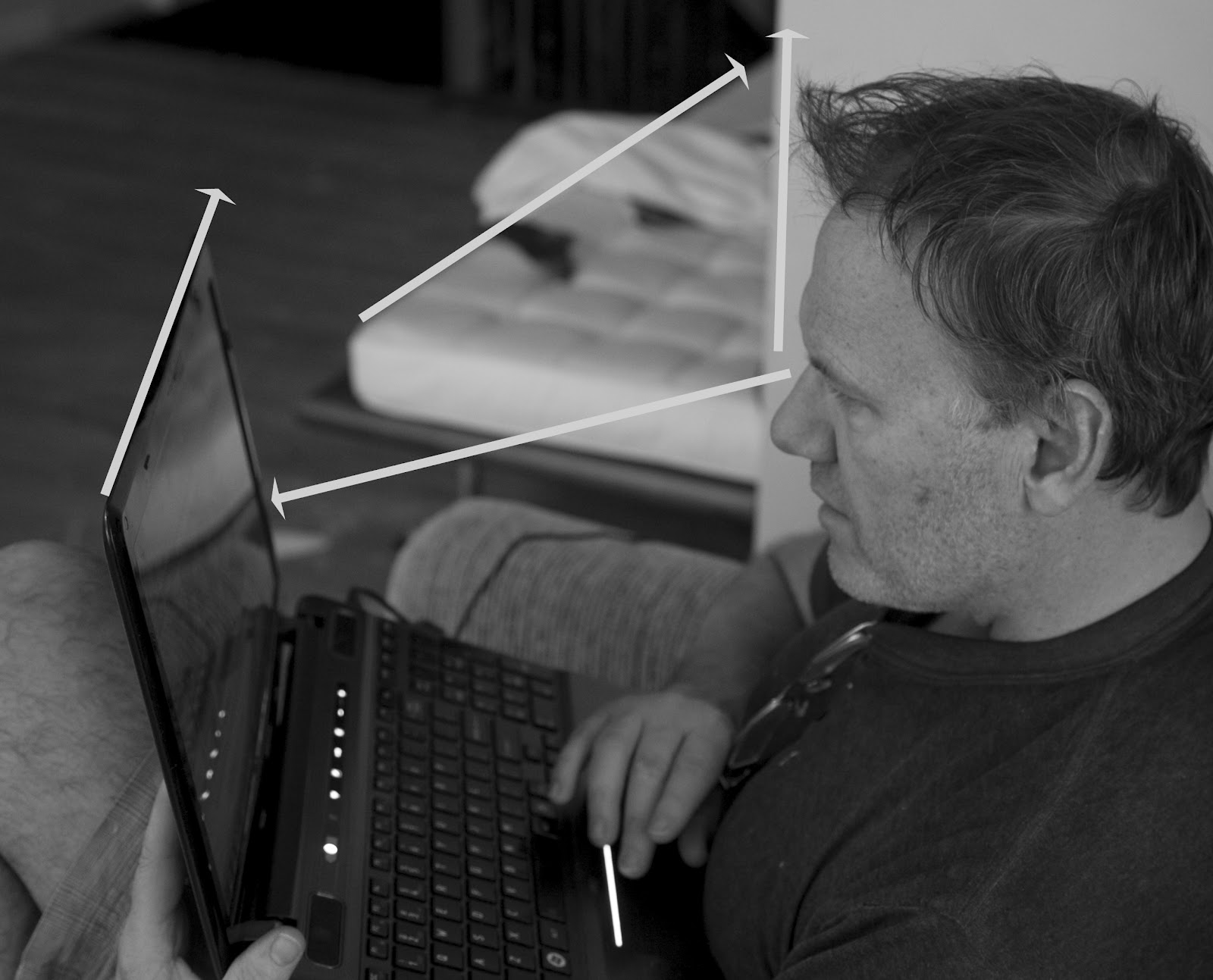
photograph 2. The implied "eye" line gaze draws our attention in a diagonal line to the laptop. In the background the side of the day-bed forms another diagonal.
Conclusion: Reflecting on the exercises above, I now appreciate, how a "suggestion" for eg, in the form of an implied "eye-line" or an extension of visible movement, can direct a viewer's gaze. Lines, points, curves and diagonals can be used subtlety to direct a viewer's gaze and add flow and movement to an image. Freeman points out that the use of such graphic elements animates a picture - for example if a line in a picture moves out of the frame, then the eye naturally moves back to see more - this creates tension and activity (2).
(1) http://en.wikipedia.org/wiki/Gestalt_psychology accessed 26/09/12)
(2) Freeman, Michael, (2007), the Photographer's Eye: Composition and Design for Better Digital Photos, The Ilex Press, p 44
(1) http://en.wikipedia.org/wiki/Gestalt_psychology accessed 26/09/12)
(2) Freeman, Michael, (2007), the Photographer's Eye: Composition and Design for Better Digital Photos, The Ilex Press, p 44


.jpg)